Social Icons

Pages

Showing posts with label bonbonland. Show all posts

Sunday, February 19, 2012

Russian Artists team meeting in Israel

It seems that our first meeting was not long ago but  it was actually almost a year ago. Our team has grown and we have a lot of new members. The life for many of us has changed or we have had some new things in our lives. I had some new things also! 

My name is Natalya and I am running the bonbonland shop on Etsy - welcome to my boutique! This was a second meeting of the Israeli division of the Russian Artist Team on Etsy. Like the first time, I had the pleasure and honor to host the meeting. 
So there we were, gathered together to share our news and experience. Let me introduce my guests!

Perhaps the most exciting news was from Sveta Nes from the nesaquarelle shop on Etsy. She has a new baby boy named Tom! Well done, mate!  
A person can see so many wonderful little works of art in Marina’s miopupazzo shop on Etsy! For example, this doll: 
 This summer the American publishing house C & T Publishing is going to release Marina's book called Enchanting Art Dolls and Soft Sculptures. There are 8 projects there. You will find out how to make a doll by yourself, the main points about sculpting, costume crazy quilting with embroidery and more. Hip-hip hooray to Marina!!!
Now, I would like to introduce two friends of mine. Please welcome Ira and Lena "Simsisters". They are two sisters and beautiful ladies who run the kimuka shop on Etsy and make the wonderful toys and excellent pictures. They bring smiles and positive energy to my life and to the life of everyone who are lucky enough to be in their circle.
Take a look at Svetlana's (Lirigal) work. Her beautiful jewelry pieces are simply masterpieces made from thousands of beads in different shapes and colors. 
Anna (polskyanna) came to our meeting from Ashqelon which is very far away in southern Israel.
A very good friend of mine and a beautiful lady is Lena Strozhenko (justlena) who also has a wonderful shop with about two thousands sales. She makes more and more beautiful items!
I am happy to introduce a new member of our team, Ira who runs irushka shop on Etsy. I found her a very charismatic lady and a wonderful artist. This is what I love about meetings of this kind, you can always meet a new friend!
Our meeting was great and I am looking forward to see my old and new friends again.

Happy ETSY-shopping!

By Natalya (bonbonland)

Monday, December 19, 2011

Hanukkah

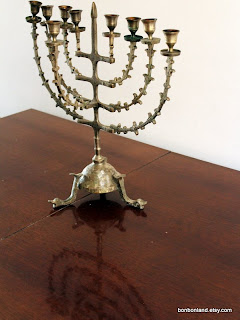
Hanukkah or Chanukah (both spellings are right) is the eight day festival of lights that begins on the eve of the 25th of the Jewish month of Kislev. It celebrates the triumph of light over darkness, of purity over adulteration, of spirituality over materiality. This year Hanukkah begins at sunset on Tuesday, December 20th and ends at sunset Wednesday, December the 28th.

 More than twenty-one centuries ago, the Holy Land of Israel was occupied by the Seleucids. At the start, their rule was fairly benign. But the troubles began in earnest when Antiochus "the madman" ascended to the throne over the Syrian-Greek empire. He enacted a series of harsh decrees. Jewish worship was forbidden; the scrolls of the Jewish Law (Bible) were confiscated and burned. Sabbath (Saturday) rest, circumcision and the dietary laws were prohibited.
One day Mattityahu, the old priest from village of Modyin, rebelled against the invaders. Together with his sons, relatives and friends (called Maccabees) they exclaimed: "Let us fight unto death in defense of our motherland, our freedom, our souls and our Temple!" Against all odds, a small group of these faithful Jews, leaded by Judah, son of Mattityahu, and his brothers, defeated one of the mightiest armies on earth, drove the Seleucids from the land, and liberated Jerusalem. The Maccabees entered the Temple and cleared it of the idols placed there by the Syrian vandals. Judah and his followers reclaimed the Holy Temple and built a new altar, which he dedicated on the twenty-fifth of the month of Kislev, in the year 3622 (remember – there is the 5772 year now) after creation of the world . And they completely rededicated the Temple to the service.
But when they sought to light the Temple's menorah (the seven branched candelabrum), they found only a single cruse of pure olive oil bearing the seal of the High Priest. It was sufficient to light only for one day. By miracle it continued to burn for eight days, till new oil could be prepared under conditions of ritual purity. To commemorate and publicize this miracle and heroism of Maccabees, the Jewish sages instituted the festival of Chanukah. 
 At the heart of the festival is the nightly hahukkiah lighting: a single flame on the first night, two on the second evening, by increasing the number of candles each night till the eighth night of Chanukah, when all eight lights are kindled. By the end of the festival forty-four candles should have been kindled in total. Why not 36 (1+2+3+4+5+6+7+8)? Because each time we first light a special service candle and then light the other candle or candles from it. This special service light called ‘shamash’ - the “servant” candle that kindles the other lights—it should be placed apart from the rest (higher, outside the row, etc.). And even there is no prescribed design for a chanukiah (Chanukah menorah), but the common is that all the lamps or candles should be arranged in a straight row, and should be of equal height and shamash should be set at a different elevation from the others so that it may be easily distinguished and recognized.
  You can see not only family Chanukah menorahs but a lot of large public menorahs all around the world – Columbia University, New York; Barcelona, Spain; Berlin, Germany; Brussels, Belgium; Buenos Aires, Argentina; Miami Beach, Florida; Kiev, Ukraine – and of course in Israel – in all these places and many others you can see public Chanukah menorah lightings usually hold by local Chabad-Lubavitch organizations.
On Chanukah Jews also add to their prays especial thanksgiving to G-d for "delivering the strong into the hands of the weak, the many into the hands of the few... the wicked into the hands of the righteous".
Chanukah customs include eating foods fried in oil like potato pancakes called ‘latkes’ (in Yiddish) and doughnuts called ‘sufganiot’  (in Hebrew).
Kids play with the special Chanukah toy called ‘dreidel’ in Yiddish or ‘sevivon’ in Hebrew. It is a spinning top, whirligig on which are inscribed the four Hebrew letters. The letters are ‘nun’,’ gimmel’, ‘hei’ and ‘shin’ or ‘pei’, depending on the place. These letters is an acronym for Hebrew sentence ‘Nes Gadol Hayah Sham’ means "a great miracle happened there". But in the Land of Israel the last letter ‘shin’ changed by letter ‘pei’ and the meaning of the sentence changes to ‘Nes Gadol Hayah Poh’ means “a great miracle happened here’! 
One of the loveliest Chanukah customs is the giving of Chanukah 'gelt' (gifts of money) to children.
 Story by Natalya (bonbonland)

Sunday, September 25, 2011

Rosh Hashanah - Jewish New Year


On the Wednesday evening, sunset September 28, 2011, the Jews will celebrate Rosh Hashanah. The two-days-long holiday starts at evening since days in the Hebrew calendar begin at sundown, after the third star could be seen on the sky.


Rosh Hashanah literally means “head” or start of the [new] year. It is the new year for people, animals, and legal contracts. Jews have another three “new years” for different purposes, for example, “Tu B’shvat” - the new year for trees and plants occurs in the sunset of February, 7, 2012.


Rosh Hashanah represents the very First day of the world – the birthday of our Universe, the day of Creation. But some people believe this day represents the creation not of the world, but of Adam, the first man, and thus the word has been created five days before. In accordance with Jewish tradition the coming year will be 5772-nd from the beginning. The Jews believe that three books of account are opened on Rosh Hashanah, wherein the fate of the wicked, the righteous, and those of an intermediate class are recorded. The names of the righteous are immediately inscribed in the book of life, and they are sealed "to live." The middle class are allowed a respite of ten days, until Yom Kippur, to repent and become righteous; the wicked are "blotted out of the book of the living forever" (Psalms, #69:29). Together Rosh Hashanah and Yom Kippur are often referred as High Holy days.

Because Jews believe that a person’s fate for the coming year will be decided during High Holy days, it is common for Jews in this time to exam their lives and to repent for any wrongs they have committed during the previous year. This process of repentance is called "teshuvah". Jews are encouraged to make amends with anyone they have wronged and to make plans for improving in the coming year. In this way, Rosh HaShanah is all about making peace and striving to be a better person. And even though the theme of the festival is life and death, it is a holiday filled with hope. Jews believe that God is compassionate and will accept their prayers for forgiveness.

The term “Rosh Hashanah” is not used in Bible to discuss this holiday. The Bible refers to the festival as the day of judgment, the day of remembrance and the memorial with the blowing of horns. One of the most important attributes of the festival is Shofar, a ram’s horn, which is blown somewhat like a trumpet. The shofar is blown one hundred times during each of the two days of Rosh HaShanah festival and its sounding supposed to remind people about the Binding of Isaac, animal sacrifices in the Temple and importance of teshuvah, repentance.


A popular observance during this holiday is eating apples dipped in honey, a symbol of our wish for a sweet new year. Honey represents good living and wealth. The land of Israel is often called the land of "milk and honey" in the Bible.

Another symbol of Rosh Hashanah is pomegranates.


It is also said that this fruit contains 613 seeds (I tried to count them once but got wrong somewhere after two hundreds). We wish that our good deeds in the ensuing year will be as plentiful as the seeds of the fruit.

Also it is traditional to eat the head of a fish or a lamb during the Rosh HaShanah holiday meal. At least, to have it on the holiday table. The head symbolizes our commitment to be “in the head and not in the tail”. Typically, round challah bread is served, to symbolize the cycle of the year and of the life.

Another popular practice of the holiday is Tashlikh. It is a ceremony that usually takes place during the first day of Rosh HaShanah. "Tashlikh" literally means "casting off" and involves symbolically empty our pockets and casting off the sins of the previous year by tossing pieces of bread or another food into a flowing water like a creek or river. This practice is not discussed in the Bible, but is a long-standing custom started somewhere from the middle ages.

People used to send greeting post cards on Rosh HaShanah. Before the advent of modern computers these were handwritten cards that were snail mailed weeks in advance. Nowadays it is equally as common to send Rosh HaShanah e-cards or e-mail congratulations, or post them in blogs a day or two before the holiday. The common greeting at this time is “l'shanah tovah umetukah”. In Hebrew it means “for a good and sweet year”. This is a shortening of another greeting sentence that means "may you be inscribed [in the Book of Life] and sealed for a good [and sweet] year". In Yiddish, it is common to wish someone gut-yor, i.e. “good year" on and around Rosh Hashanah.


So, my dear friends and readers! Please forgive me all my voluntarily or involuntarily wrongs and resentments. Let me wish you the very healthy and prospective, good and sweet new 5772-nd year! Let the Holy One be compassionate to all of us! Please go to my internet boutique http://bonbonland.etsy.com for gifts and presents for your little princesses! And good etsy-ing to everyone! ;o)

Natalia at Bonbonland

Friday, July 29, 2011

Interview with a Star - Natasha at Bonbonland

This is not a story about me but about a dream. A successful story about a dream that came true, which I am proud to share with you…


Like a lot of girls, I started to draw dresses and attires from the early childhood. In high school I learned fashion and the textile industry. Later in college I learned sewing and sewing technology, cutting and patterning, sewing machines & techniques and many other special things. I started to work in one of the largest fashion networks in Israel, H&O ™. I worked there ten years and went a long way from a saleswoman position to a fashion consultant and shop supervisor. I am very pleased because the work in H&O gave me a lot of knowledge and experience.


After the 15 years of working in fashion industry I got enough self confidence to start my own business. In 2007 I founded a fashion studio "Shirel". This word is actually my second name and means in Hebrew "God's Song". I believe all my life is the song dedicated to God…


My work day in the studio usually consists of fashion and design projects, cutting and shaping, fitting and trying on, sewing and preparing patterns, templates and samples. Also there are constant negotiations, work with customers and sales. In my studio we made a lot of patterns for evening dresses and outfits, blouses and tops. I am happy to work with leading Israeli fashion designers.


After almost three years of very hard work I started my favorite project – the internet boutique "bonbonLand" on ETSY. Actually I am running three shops on ETSY, also “Bandannas" and Felt scarves and necklaces. But bonbonLand is my favorite project. It allows me to work for the most beautiful creatures - for little princesses, for baby girls.


I am very happy woman. I have lovely husband, typical software "genius". I have two wonderful sons. But my work in bonbonLand project is the thing I enjoy most of all in my life. It gives me such a great feelings that could be compared with the pure real happiness possible only in an early childhood.


Every time I prepare baby bloomers or a small dress for a baby girl, I can imagine a little princess sitting or walking among the flowers or meadows in a gentle summer sunny day. I imagine photo props and bright and beautiful babies in bright and beautiful dresses. I imagine parents and grandparents smiling at a picture of their beloved daughters and granddaughters and tears flow from the depths of my soul…


I love all my small clients. And am happy to have the ability to realize this love. The possibility to give my love, my heart and a little part of my soul to every baby that wears my products, my wares. BonbonLand is not about the business, at least not only about the business. It is about the love, the love I share with my beloved baby clients and models. Nowadays almost a hundred baby girls wear the dress with the "bonbonLand" label.


I had a dream when I was young. I am happy that my dream came true.
Related Posts Plugin for WordPress, Blogger...